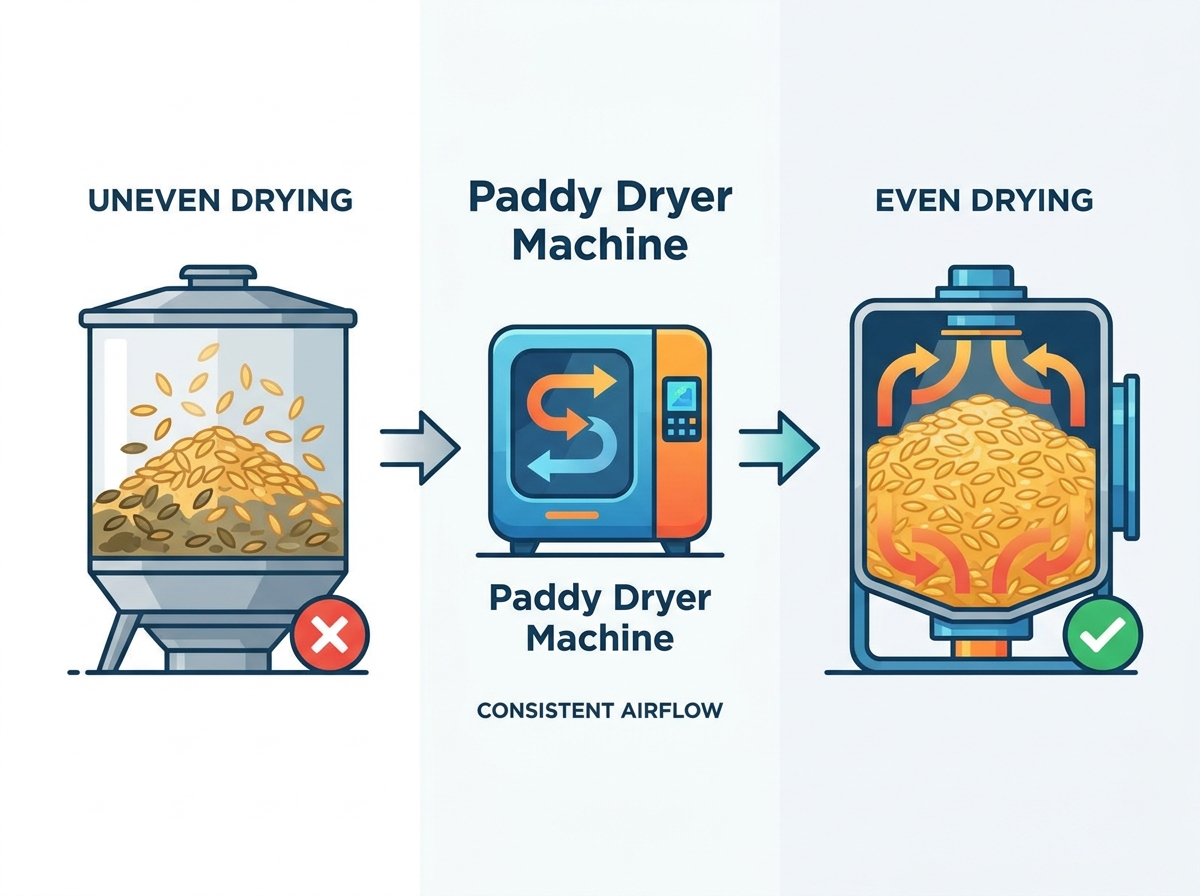
Uneven moisture content in harvested paddy directly degrades head rice yield during milling. You lose premium profits to low-value broken grain. Freshly harvested rice carries high moisture levels that trigger rapid biological deterioration. Traditional sun drying and sub-optimal ambient air methods fail to manage this moisture uniformly. They create localized wet spots and severe thermal stress across the grain bed. This combination inevitably leads to grain fissuring, aggressive mold development, and significant volume loss during storage and processing.
Modern mechanical drying systems provide the definitive solution for controlling post-harvest thermodynamics. By standardizing airflow and regulating heat application, a high-quality paddy dryer machine ensures uniform moisture reduction across commercial harvests immediately after collection. Implementing these systems halts biological degradation, stabilizes the crop for long-term silo storage, and maximizes the extraction of whole, intact kernels.
Fresh paddy must be processed immediately after harvest; mechanical dryers halt rapid biological degradation and stabilize the crop for storage.
Uniform drying requires precise control of plenum temperature and airflow distribution—variables that mechanical systems strictly regulate compared to ambient drying methods.
Pre-cleaning harvested paddy is a non-negotiable operational prerequisite; foreign debris creates air pockets that guarantee uneven drying regardless of the dryer's technological capabilities.
Selecting the right architecture—such as a batch paddy dryer versus a continuous flow system—depends heavily on facility intake volume, moisture variability, and whether the facility processes raw or parboiled rice.
Routine calibration of moisture sensors, alongside rigorous pre-season and in-season maintenance, is critical to sustaining the efficiency and uniformity of grain drying equipment over its lifecycle.
The Cost of Uneven Drying in Post-Harvest Processing
Moisture Gradients and Grain Fissuring
Rice kernels crack easily under rapid environmental changes. When you expose paddy to uncontrolled heat, surface moisture evaporates faster than internal moisture migrates outward. This differential creates a severe moisture gradient. The outer layers contract while the inner core remains swollen. This opposing physical force generates immense internal tension. The endosperm fractures or fissures. Once a kernel develops microscopic internal cracks, it loses structural integrity. When this fissured grain passes through the abrasive pressure of a rice whitener, it shatters. You see a drastic reduction in head rice yield. Highly profitable whole grains turn into low-value broken fragments. Managing the thermodynamics of the drying process is the only way to prevent this mechanical failure.
Biological Risks and Storage Spoilage
Uneven drying leaves dangerous pockets of high-moisture grain hidden within the bulk mass. These localized wet spots become highly active biological zones. When moisture levels in specific pockets stay above the safe storage threshold of 14%, the grain respires rapidly. It generates localized heat. This warm, damp micro-climate provides exact conditions for fungal proliferation. Aspergillus flavus thrives here and produces toxic aflatoxins. These wet spots also attract storage pests like weevils and borers. As insects feed and reproduce, they generate more metabolic heat and moisture. This triggers a chain reaction of spoilage that quickly spreads from a single wet spot to contaminate an entire storage silo. You cannot rely on silo aeration fans to fix wet spots created by poor initial drying.
Logistical and Storage Inefficiencies
Failing to achieve uniform moisture levels disrupts facility logistics. Freshly harvested paddy contains excess water weight and occupies a larger physical volume. Proper drying naturally reduces the bulk quantity of the harvest. When drying is uneven, operators cannot accurately calculate the true dry weight of their inventory. Transporting under-dried grain means paying freight costs to move water. Storing unevenly dried grain requires excessive aeration in silos to manage wet spots. This consumes massive amounts of electrical power. Achieving a uniform moisture profile maximizes usable silo capacity. It ensures transport logistics remain highly cost-effective and predictable.
Economic Impact on Milling Yield
The financial consequences of uneven drying compound at every processing stage. The global rice market dictates a steep price penalty for broken grains. A facility producing unevenly dried paddy experiences a measurable percentage drop in premium whole-grain output. For high-capacity mills, even a two percent reduction in head rice yield translates to massive annual financial losses. Uneven drying also causes inconsistent coloration and poor cooking characteristics. This damages brand reputation and limits access to premium export markets. You must view the drying phase as a primary profit center, not just a preliminary processing step.
Core Mechanisms: How a Paddy Dryer Machine Achieves Uniformity
Controlled Hot Air Circulation
The foundation of uniform moisture extraction lies in forced-air systems. Modern mechanical dryers utilize high-capacity centrifugal or axial blowers. They push heated air into a central plenum chamber. This plenum acts as a pressurized distribution manifold. It forces hot air evenly outward through the perforated walls of the grain holding bins. By maintaining consistent static pressure across the drying bed, the system eliminates dead zones. The volume and velocity of the air are carefully calibrated. Every individual kernel receives an identical volume of thermal energy. This facilitates a steady, uniform evaporation rate across the entire batch, regardless of the grain's position in the column.
Grain Inversion and Mechanical Mixing
If grain remains stationary against a heat source, layers closest to the plenum over-dry. Outer layers remain wet. Advanced mechanical systems employ continuous movement and grain inversion techniques. In recirculating systems, bucket elevators draw grain from the bottom of the drying chamber. They deposit it back at the top. As grain descends, gravity-flow baffles and specialized mixing chutes force kernels to tumble. This mechanical mixing ensures a kernel near the hot inner screen during one pass moves near the cooler outer screen next. This constant repositioning guarantees equal exposure to heated airflow. It prevents the severe moisture stratification common in static flat-bed dryers.
Automated Moisture Monitoring
Achieving precise uniformity requires continuous data collection. Modern drying systems integrate digital capacitance moisture sensors directly within the drying chamber. These sensors take real-time readings of the grain's moisture content. This data feeds into a central programmable logic controller. If sensors detect rapid moisture extraction, the controller automatically modulates burner intensity. It lowers the plenum temperature to prevent thermal shock. If the drying rate slows, the system adjusts airflow or heat. This automated feedback loop removes human guesswork. It prevents over-drying and under-drying, ensuring the final product meets exact milling specifications.
Evaluating Grain Drying Equipment for Your Facility
Batch Paddy Dryer Systems
For small-to-medium milling operations, a batch paddy dryer offers unmatched control. These systems process a specific, fixed volume of grain at one time. The primary advantage is the ability to tightly control the final moisture content of that specific load. The grain continuously loops through heating and tempering sections. Operators execute highly specific drying curves tailored to the exact initial moisture of that batch. The batch architecture excels at handling harvests with highly variable incoming moisture levels. It ensures the final discharged product is perfectly uniform before you introduce the next load.
Continuous Flow Dryers
Large-scale commercial operations requiring massive daily throughput rely on continuous flow architectures. Wet grain constantly feeds into the top of the dryer. Dried grain simultaneously discharges from the bottom. The grain passes through distinct heating and cooling zones in a single descent. To operate efficiently, continuous flow grain drying equipment requires a steady intake of paddy with a consistent initial moisture level. If incoming moisture fluctuates wildly, the system struggles to adjust. Facilities must implement rigorous pre-drying grain segregation and blending strategies. This feeds the machine a homogenized product, allowing it to maintain maximum processing speed.
Specialized Parboiled Rice Dryer Considerations
Processing parboiled rice introduces extreme thermodynamic challenges. The parboiling process involves soaking and steaming the rough rice. This drives initial moisture content well above 30% and fully gelatinizes the internal starch structure. Extracting this massive volume of water requires a specialized parboiled rice dryer. These machines execute multi-stage drying phases separated by extended tempering periods. If parboiled rice dries too quickly in a single pass, the hardened outer layer cracks violently. Specialized parboiled dryers utilize lower airflow velocities and specific temperature step-downs. They gently draw moisture from the core without compromising structural integrity.
Dryer Architecture
Best Use Case
Moisture Control Capability
Throughput Capacity
Recirculating Batch
Small-to-medium mills, mixed varieties
Excellent for variable incoming moisture
Low to Medium
Continuous Flow
Large-scale commercial operations
Requires homogenized initial moisture
High
Specialized Parboiled
Parboiled rice processing facilities
Handles 30%+ moisture and gelatinized starch
Medium to High
Operational Prerequisites to Prevent Wet Spots
The Urgency of Immediate Post-Harvest Drying
The mechanical drying process cannot reverse damage that occurs before the grain enters the machine. Freshly harvested paddy is a living biological organism with a high respiration rate. If wet paddy sits in transport trucks for 12 to 24 hours, metabolic heat causes the temperature of the pile to spike. This rapid heat buildup initiates fermentation and causes dry matter loss. Kernels turn yellow or brown. Moving fresh paddy into the dryer immediately after harvest is a critical operational mandate. Prompt moisture extraction halts respiration and preserves the natural color of the grain. You must coordinate field harvesting schedules directly with dryer intake capacity.
The Critical Role of Pre-Cleaning
Feeding uncleaned grain into a mechanical dryer guarantees an uneven final product. Harvested paddy contains significant amounts of foreign debris. Chaff, straw, weed seeds, dust, and unfilled grains accumulate and block perforated screens. This debris alters static pressure within the grain bed. It creates dense pockets where hot air cannot penetrate. These obstructed zones become micro-climates of high moisture. Pre-cleaning the harvested paddy through scalpers and aspirators is mandatory. Removing foreign matter ensures consistent aerodynamic resistance across the entire grain mass. This allows blowers to distribute heat evenly and eliminate wet spots.
Managing Initial Moisture Variability
Harvest conditions are rarely uniform. Paddy harvested early in the morning has a higher moisture content due to dew. Grain from shaded areas differs from grain exposed to full sun. If operators dump highly variable loads directly into the same drying batch, the machine outputs a mixed-moisture final product. Facility managers must implement intake testing and segregation protocols. Group incoming loads with similar moisture profiles into specific holding bins. This allows automated sensors and burner controls to execute a single, optimized drying curve for the entire volume.
Tempering Phases and Target Moisture Levels
Continuous heat application is detrimental to grain quality. Uniform drying requires alternating periods of active heat exposure and resting phases, known as tempering. During active heating, moisture rapidly evaporates from the surface. During tempering, the grain moves away from the heat source. Trapped internal moisture slowly migrates outward and equalizes with the drier surface. This equalization prevents severe internal tension that causes fissuring. For short-term holding before milling, reaching 18% moisture is sufficient. For long-term silo storage, paddy must be dried down to a uniform 14% or lower to guarantee biological stability.
Implementation Risks and Maintenance Trade-offs
Optimizing Plenum Temperatures for Efficiency vs. Quality
Facility operators constantly face the trade-off between drying speed and grain quality. Running the dryer's plenum at higher temperatures increases the rate of evaporation. You process more tons per hour. However, pushing the temperature too high crosses a critical threshold. Excessive heat causes starch granules to degrade. You see severe discoloration and massive fissuring rates. Operators must establish the maximum safe temperature threshold for their specific grain variety. If the percentage of broken grains increases during test milling, reduce the plenum temperature immediately. Prioritize the high market value of whole grains over raw processing speed.
Pre-Season and In-Season Mechanical Maintenance
The uniformity of a drying system degrades rapidly without rigorous mechanical upkeep. Consistent maintenance ensures the machine performs to its engineered specifications. Follow these mandatory maintenance steps to prevent airflow disruptions and uneven heating:
Inspect all blowers and axial fans for aerodynamic efficiency before the harvest season begins.
Verify that drive belts are tight and fan bearings are properly lubricated to maintain consistent RPMs.
Clean burner nozzles to maintain a proper stoichiometric fuel-to-air ratio and prevent soot buildup.
Clear dust and chaff from the perforated screens daily during active operational windows.
Empty and clean the bucket elevator boots to prevent wet grain accumulation and cross-contamination.
Calibrate digital moisture sensors against a certified benchtop meter weekly.
Energy Consumption vs. Drying Efficiency
Mechanical drying is an energy-intensive process. It requires significant inputs of electrical power for blowers and elevators, alongside fuel for burners. Operators evaluate the operational costs of achieving perfectly uniform drying against the financial gains of a higher head rice yield. Poorly maintained dryers consume excess fuel to achieve the target moisture drop. Implementing variable frequency drives on main blowers and upgrading to high-efficiency modulating burners drastically reduces energy consumption. The fuel and electrical costs incurred by running a highly efficient dryer are offset by the maximization of premium milled rice output.
Conclusion
Investing in a high-quality mechanical drying system is a direct, strategic investment in maximizing milling yield. It reduces bulk storage costs and protects the total market value of the crop. By eliminating severe moisture gradients and biological risks, modern equipment ensures every kernel retains its structural integrity from the field to the milling floor. Match the dryer architecture to your specific operational realities. Assess your peak daily harvest intake and evaluate the available physical footprint of your facility.
To optimize your post-harvest processing immediately, take the following steps:
Conduct a comprehensive audit of your current post-harvest milling losses to quantify the financial impact of broken grains.
Assess your facility's power and fuel availability to determine the most cost-effective burner and blower configurations.
Implement strict intake segregation and pre-cleaning protocols to ensure only clean, homogenized grain enters the drying system.
Request specific performance data and moisture uniformity guarantees from equipment manufacturers before finalizing any purchase.
FAQ
Q: How quickly should fresh paddy be dried after harvest to prevent spoilage?
A: Fresh paddy should enter the drying process within 12 to 24 hours of harvest. Delaying moisture extraction allows the grain to respire rapidly. This generates metabolic heat that triggers fermentation, discoloration, and rapid mold development, permanently damaging crop quality.
Q: What is the ideal final moisture content for short-term versus long-term storage of paddy rice?
A: For short-term holding under two weeks prior to immediate milling, paddy can be safely held at 18% moisture. For long-term silo storage, the grain must be uniformly dried to 14% or lower to completely halt biological activity and prevent fungal growth.
Q: How does a recirculating batch paddy dryer differ from a continuous flow dryer?
A: A recirculating batch dryer processes a fixed volume of grain, continuously looping it through heating and tempering zones until the entire load reaches the target moisture. A continuous flow dryer constantly intakes wet grain at the top and discharges dry grain at the bottom in a single pass.
Q: Can a parboiled rice dryer be used efficiently for raw paddy?
A: While possible, it is highly inefficient. Parboiled dryers are engineered with specialized tempering zones and airflow dynamics designed to handle grain with over 30% moisture and gelatinized starch. Using them for raw paddy results in excessive energy consumption and sub-optimal drying curves.
Q: Why is pre-cleaning strictly necessary before using grain drying equipment?
A: Pre-cleaning removes chaff, straw, and dust that obstruct airflow within the dryer. If this debris enters the machine, it blocks perforated screens and alters static pressure. This creates stagnant air pockets that guarantee uneven drying and localized wet spots.
Q: What causes grain fissuring during the mechanical drying process?
A: Fissuring occurs when moisture evaporates from the surface of the kernel much faster than internal moisture can migrate outward. This creates a severe moisture gradient and internal physical tension. If the plenum temperature is too high, the kernel fractures under this stress.