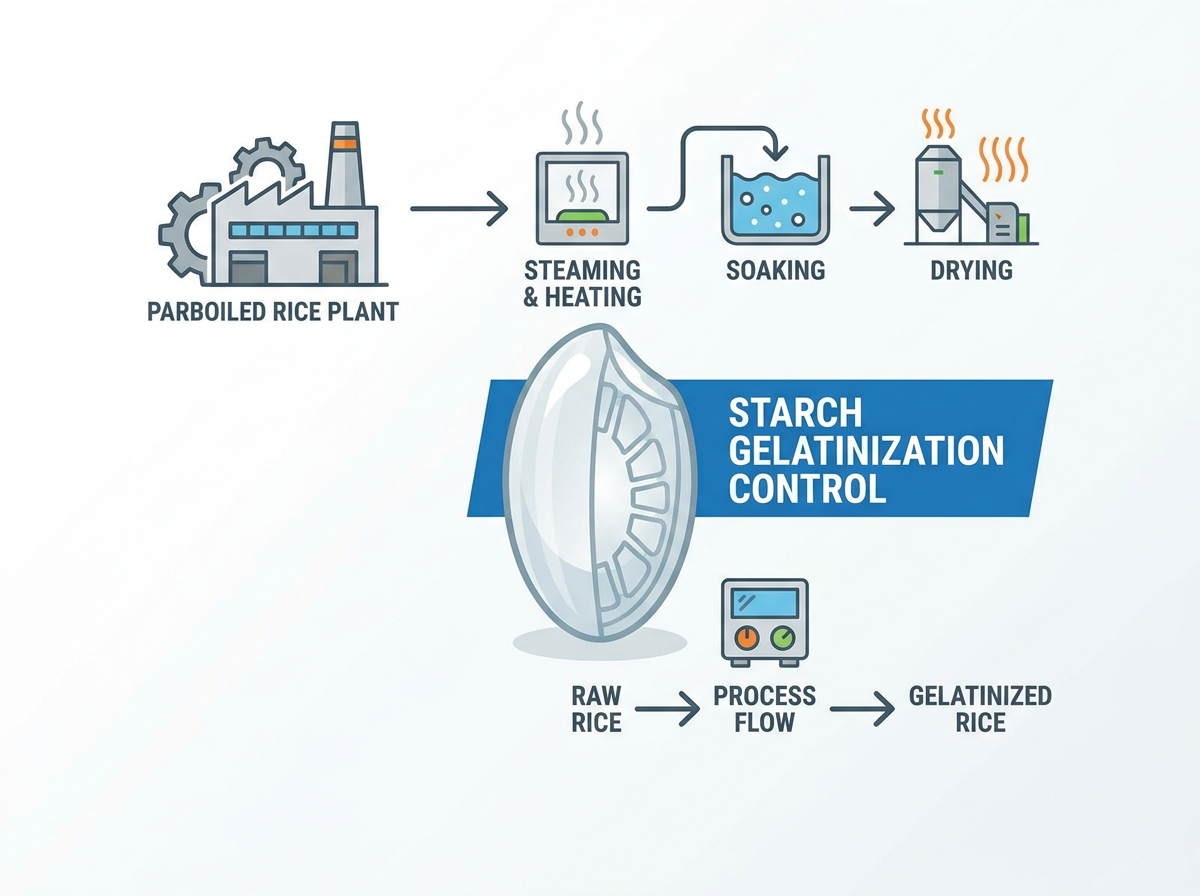
The profitability of parboiled rice hinges on a single biochemical event: starch gelatinization. Precise execution increases grain hardness, maximizes head rice yield, and enhances nutritional value. Poor execution leads to breakage and discounted product. Plant operators face constant challenges balancing moisture, heat, and pressure. Inconsistent parameters result in under-gelatinized grains, indicated by a brittle "white core." Over-processed grains suffer from discoloration, nutrient degradation, and texture loss. Selecting the right equipment requires moving beyond basic capacity metrics. Evaluating a facility’s thermal dynamics, steam distribution, and automated control systems ensures consistent, verifiable gelatinization at scale. A highly optimized parboiled rice processing plant integrates these variables, ensuring every batch meets strict quality standards while minimizing energy waste and mechanical failures.
Gelatinization requires a precise combination of moisture saturation (typically >30%) and controlled thermal energy (steam) to permanently alter the starch structure.
The steaming vessel is the primary control center; industrial evaluation must focus on steam distribution uniformity and pressure retention capabilities.
Post-steaming stabilization is equally critical; an optimized parboiled rice grain dryer halts gelatinization and prevents endosperm fissuring prior to milling.
Modernizing a facility requires evaluating the trade-offs between automated PLC (Programmable Logic Controller) systems and manual valve controls regarding batch consistency, recipe management for different paddy varieties, and energy expenditure.
The Mechanics of Starch Gelatinization in Rice Processing
Defining the Biochemical Threshold
Starch gelatinization is an irreversible thermal process. Intermolecular bonds within starch granules break down in the presence of water and heat. For rice processing, this threshold is highly specific. Granules must absorb sufficient water to swell, lose their birefringence, and melt into a cohesive, uniform mass. The exact temperature required to trigger this phase transition depends heavily on the amylose-to-amylopectin ratio of the specific paddy variety. High-amylose varieties require more thermal energy to break down crystalline structures. This pushes the gelatinization temperature toward the upper limit of the typical 65°C to 75°C range. Low-amylose varieties gelatinize at lower temperatures. Operating a facility without adjusting for these biochemical variances guarantees inconsistent product quality across different harvest batches. Plant engineers must profile incoming paddy batches to set baseline thermal targets before initiating the steaming sequence.
Success Criteria for Gelatinization
Successful starch gelatinization yields specific, measurable physical and nutritional outcomes. The primary mechanical benefit is the sealing of natural microscopic fissures present in the raw endosperm. Melting the starch into a solid matrix gives the grain significant structural integrity. This directly translates to higher head rice yields during the milling phase. Operators often see head rice yields jump from 55% in raw milling to over 65% after proper parboiling. Nutritionally, the hydrothermal process forces water-soluble B-vitamins, specifically thiamine and niacin, present in the bran layer to migrate deep into the starchy core. This migration locks in essential nutrients that would otherwise be stripped away during polishing. The hardened endosperm also provides robust resistance to post-harvest pests, particularly Sitophilus oryzae (the rice weevil), extending the shelf life of the final product in storage silos.
Visual and Analytical Indicators
Operators track the progress of gelatinization through visual cues and rigorous analytical testing. The most obvious physical transformation is the shift from an opaque, chalky endosperm to a fully translucent grain. The presence of a "white core" defect serves as the primary visual indicator of incomplete gelatinization. This defect occurs when moisture and heat fail to penetrate the center of the grain. It leaves raw, brittle starch that shatters easily under milling pressure. Plant-floor quality assurance relies on specific steps to monitor this:
Sample collection from the steaming vessel discharge every 30 minutes during active processing.
Rapid surface cooling of the sample using forced ambient air to halt residual cooking.
De-husking the sample manually using a rubber-roll hand tester to expose the brown rice.
Placing the brown rice kernels on a backlit glass inspection board to check for opacity.
Counting the percentage of grains exhibiting opaque centers to determine the defect rate.
Modern facilities supplement these checks with objective laboratory measurements. Differential Scanning Calorimetry (DSC) measures the exact thermal energy required to melt residual ungelatinized starch. Alkali Spreading Tests provide a chemical assessment of starch degradation. These analytical tools eliminate guesswork. They allow operators to fine-tune steaming parameters with absolute precision rather than relying solely on visual estimates.
Core Equipment in a Parboiled Rice Processing Plant for Gelatinization Control
Hydrothermic Soaking Tanks: Establishing the Moisture Baseline
Pre-conditioning the paddy is an absolute prerequisite for even gelatinization. Hydrothermic soaking tanks facilitate this by elevating the internal moisture content of the raw grain to a minimum saturation point, typically above 30%. Without uniform moisture distribution, the subsequent steaming phase causes localized over-processing on the grain's surface while leaving the core dry and ungelatinized. The soaking phase dictates the baseline for all downstream thermal dynamics. Water chemistry also plays a role. High mineral content in the soaking water can inhibit moisture penetration, requiring longer residence times. Tanks are typically constructed from 304 stainless steel to prevent corrosion from the slightly acidic soaking water environment.
When evaluating soaking systems, operators compare ambient versus hot water configurations. Ambient soaking requires significantly longer cycle times, sometimes up to 72 hours. This severely limits plant throughput and introduces a high risk of premature fermentation. Fermentation produces distinct off-odors that permanently taint the final product. Hot water soaking systems operate between 60°C and 70°C. They drastically reduce cycle times to just a few hours. Rapid hydration prevents bacterial growth and accelerates production. It requires precise temperature control to prevent the starch from gelatinizing prematurely inside the soaking tanks before it reaches the pressurized vessels.
Pressurized Steaming Vessels: The Gelatinization Engine
The steaming vessel acts as the thermal engine of the entire operation. Its function is to inject pressurized steam into the moisture-laden grain. This forces heat through the outer bran layers and into the core to trigger the starch phase transition. The mechanical design of this vessel determines the uniformity and depth of gelatinization. Steam dispersion manifolds must be engineered to deliver heat evenly across the entire grain bed. Poor manifold design creates cold spots that lead to white core defects, while localized hot spots cause severe grain darkening.
Structural integrity and pressure ratings are primary evaluation dimensions. Atmospheric steaming vessels represent a lower capital investment but suffer from high temperature variance and limited gelatinization depth. They are generally unsuitable for high-capacity industrial operations demanding strict quality control. Pressurized steaming vessels require higher capital but offer precise control over the thermal environment. Operating under pressure drives steam deep into the grain matrix rapidly. This ensures complete core gelatinization without overcooking the outer layers. Vessel walls must meet strict ASME boiler and pressure vessel codes to handle the cyclic fatigue of repeated batch pressurization and depressurization.
Boiler and Steam Distribution Systems
The effectiveness of the steaming vessels relies entirely on the boiler and steam distribution network. Delivering consistent steam pressure and quality is non-negotiable. The system must provide dry, saturated steam. Wet steam introduces excess surface moisture to the grain, causing clumping and uneven heat transfer. Localized over-processing degrades grain color. Under-processing compromises milling yields.
Evaluating this infrastructure requires a deep dive into boiler capacity requirements. The unit must handle peak loads during simultaneous batch steaming without pressure drops. Steam trap efficiency is another major factor. Malfunctioning traps, whether thermodynamic or inverted bucket types, allow condensate to pool in the lines. This degrades steam quality and causes water hammer, which can physically damage the piping network. Pressure-regulating valves (PRVs) serve as the final control point before the steam enters the processing vessels. These valves must maintain exact setpoints. Minor pressure fluctuations drastically alter the gelatinization temperature and ruin an entire batch.
Evaluating a Complete Parboiled Rice Line: Key Control Variables
Pressure and Temperature Calibration
The correlation between pressure settings and final product quality is direct and unforgiving. Specific pressure settings, typically ranging from 1.5 to 2.5 kg/cm², dictate the depth of gelatinization and the final color of the grain. Lower pressure ranges yield light parboiled rice, favored in certain regional markets. They require longer exposure times to ensure core penetration. Higher pressure ranges accelerate gelatinization and produce a darker, more amber-colored grain. A complete parboiled rice line must provide the mechanical flexibility to target these specific color and hardness grades reliably.
Operators execute dynamic adjustments to these settings based on the incoming paddy's initial moisture content and specific amylose profile. Applying a static pressure recipe to a highly variable organic input guarantees inconsistent output. High-fidelity temperature sensors, such as industrial RTDs, and automated steam inlet valves maintain exact setpoints without manual lag. When a sensor detects a pressure drop, the automated valve responds instantly via a tuned PID loop to modulate the steam flow. This ensures the thermal environment remains perfectly stable throughout the gelatinization window.
Troubleshooting pressure drops requires a systematic approach on the plant floor:
Verify the main boiler header pressure remains above the minimum threshold during peak draw across all active vessels.
Inspect the PRV diaphragm for wear, rupture, or scale buildup that prevents full actuation.
Check the steam dispersion manifold inside the vessel for blockages caused by grain debris or mineral deposits.
Test the thermodynamic steam traps on the supply line to ensure they are discharging condensate properly without blowing live steam.
Steaming Duration and Batch Consistency
Exposure time is just as important as temperature and pressure. The relationship between steaming duration and the degree of gelatinization is linear up to a point. Prolonged exposure begins to degrade the nutritional profile and severely darken the grain. Over-steamed rice loses its structural integrity during milling. It breaks just as easily as under-steamed rice. Achieving the perfect balance requires strict adherence to timing protocols programmed into the control system.
Scalability introduces distinct challenges regarding residence time control. Batch systems offer precise control over individual loads. They require rigorous operational discipline to maintain consistency across multiple shifts. Continuous parboiling systems handle large tonnages more efficiently. They demand flawless mechanical design to ensure uniform steam penetration as the grain moves through the vessel. In continuous setups, the speed of the rotary valves or discharge augers must synchronize perfectly with the steam injection rate. This guarantees every grain receives the exact same thermal exposure from intake to discharge.
Post-Gelatinization: The Role of the Parboiled Rice Grain Dryer
Halting the Thermal Process
Gelatinization does not stop the moment the grain exits the steaming vessel. The biochemical process continues as long as residual heat and moisture remain trapped within the endosperm. To lock the starch structure and prevent over-processing, the facility must rapidly remove surface moisture. This is the primary function of the drying stage. An efficient parboiled rice grain dryer arrests the thermal momentum, stabilizing the grain for the subsequent milling phases.
Equipment integration plays a massive role in this transition. The mechanical transfer from the pressurized steaming vessel to the drying stage must be seamless and rapid. Any delay in material handling allows the grain to sit in its own latent heat, continuing to cook and darken. Conveyor systems and bucket elevators must be sized correctly. They need to clear the steaming vessels immediately upon batch completion. This feeds the wet, hot grain directly into the primary drying intake without bottlenecks or material bridging in the hoppers.
Moisture Stabilization to Prevent Fissures
While rapid surface drying halts gelatinization, aggressive deep drying introduces a severe implementation risk. Rapid or uneven moisture extraction causes thermal shock. This creates severe internal stress within the hardened endosperm as the outer layers contract faster than the core. The stress re-introduces fissures into the newly solidified grain. It completely negates the milling benefits achieved during parboiling. The grain will shatter inside the husker or polisher, destroying the head rice yield.
Mitigating this risk requires a multi-stage drying approach that respects the glass transition temperature of the rice. Modern facilities utilize fluidized bed dryers for the initial phase. These units rapidly flash off surface moisture while keeping the grain suspended in a cushion of hot air to prevent mechanical damage. Following this, the grain transfers to column dryers for slow, deep moisture extraction. This secondary phase incorporates tempering periods. Tempering intervals cease the drying process temporarily, allowing internal moisture to migrate to the surface naturally. This slow, controlled stabilization safely brings the paddy down to a millable state of 12-14% moisture without inducing stress fractures.
Upgrading to a Modern Rice Parboiling and Milling Plant: Trade-offs and ROI
Automation vs. Manual Control Systems
Upgrading a facility forces operators to weigh the upfront capital expenditure of automation against long-term operational stability. Integrating PLC (Programmable Logic Controller) and SCADA (Supervisory Control and Data Acquisition) systems requires a significant initial investment compared to traditional manual valve controls. Manual systems rely heavily on operator intuition and reaction time. This leads to inevitable batch-to-batch inconsistencies, wasted steam, and fluctuating product quality across different operating shifts.
The ROI of automation in a modern rice parboiling and milling plant becomes apparent through the drastic reduction of operator error. Automated systems allow for precise recipe management. Plant managers program specific soaking times, steam pressures, and drying curves for different paddy varieties. The system adjusts for amylose content automatically based on the selected recipe. A high-amylose long-grain variety receives a completely different thermal treatment than a low-amylose short-grain variety. This guarantees consistent gelatinization regardless of the raw material input.
Control System Type
Initial Capital Investment
Batch Consistency
Recipe Management
Operator Dependency
Manual Valve Control
Low
Highly Variable
Difficult / Manual Logbooks
High (Requires constant monitoring)
PLC / SCADA Automation
High
Strictly Uniform
Digital / Instant Changeovers
Low (Focus shifts to system supervision)
Energy Efficiency and Steam Recovery
Steam generation represents one of the highest ongoing operational costs in parboiling. Evaluating energy efficiency is a core financial necessity. Legacy systems often vent exhaust steam directly into the atmosphere, wasting massive amounts of latent heat. Upgrading to a modern facility involves assessing systems that capture and reuse this exhaust steam. Routing flash steam back into the soaking tanks to pre-heat the water reduces the boiler's total load and cuts fuel consumption.
Fuel sourcing dictates long-term profitability. Utilizing biomass, specifically the rice husks generated as a byproduct of the milling phase, to fuel the boilers creates a closed-loop energy system. Biomass boilers require specialized grate designs and emission control scrubbers. This increases the initial installation complexity. Eliminating reliance on fossil fuels significantly lowers the energy cost per ton of processed rice. It provides a rapid return on investment and insulates the facility from volatile global fuel markets.
Implementation Risks in Retrofitting vs. Greenfield Projects
Deciding between retrofitting an existing legacy milling line and constructing a purpose-built greenfield facility involves distinct engineering challenges. Retrofitting requires integrating new pressurized steaming vessels and high-capacity multi-stage dryers into an existing footprint. This exposes severe infrastructure limitations. Existing steam lines may be undersized, failing to deliver the volume required by modern vessels. Structural load capacities of older buildings may not support the massive weight of water-filled soaking tanks or towering column dryers.
Mitigating these implementation risks demands comprehensive vendor engineering audits long before equipment procurement begins. Audits must focus on mapping steam line sizing, calculating structural load capacities, and identifying material handling bottlenecks. If the existing bucket elevators cannot clear a newly installed high-capacity steaming vessel fast enough, the entire upgrade is compromised. The hidden costs of reinforcing infrastructure and modifying layouts often make greenfield projects the more financially sound long-term strategy. Greenfield facilities are designed around the optimal thermal and mechanical flow from day one.
Conclusion
Conduct a comprehensive thermal audit of your current processing lines to identify steam pressure drops and temperature inconsistencies.
Define your target head rice yields and specific color grades before evaluating new steaming vessels.
Request detailed P&ID (Piping and Instrumentation Diagrams) from equipment manufacturers to verify the logic of their steam distribution and recovery systems.
Evaluate the material handling capacity between your steaming and drying stages to ensure rapid transfer and prevent over-processing.
FAQ
Q: What causes a white core in parboiled rice?
A: A white core indicates incomplete starch gelatinization. This defect occurs due to insufficient soaking time, low steam pressure, or inadequate steaming duration. When moisture and heat fail to penetrate the center of the grain, the core starch remains unaltered and brittle, leading to breakage during milling.
Q: How does parboiling affect the nutritional value of rice?
A: The hydrothermal process of parboiling forces water-soluble B-vitamins and minerals present in the bran layer to migrate into the starchy endosperm. This locks the nutrients inside the grain, preventing them from being stripped away during the subsequent polishing phase, resulting in a highly nutritious final product.
Q: What is the ideal moisture content before milling parboiled paddy?
A: Parboiled paddy must be dried and stabilized to a moisture content of 12% to 14% before milling. Milling at higher moisture levels causes the grain to mash inside the machinery, while drying below 12% induces severe brittleness and increases the rate of broken grains.
Q: Why do parboiled rice grains turn dark during processing?
A: Grain darkening is primarily caused by excessive thermal exposure. High steam pressure, prolonged steaming duration, or delays in transferring the hot grain to the drying stage cause the sugars and amino acids in the rice to undergo a Maillard reaction, resulting in an amber or dark brown color.
Q: Can you parboil rice without pressurized steaming?
A: Yes, atmospheric steaming is possible, but it is highly inefficient for industrial scale. It operates at lower temperatures, resulting in shallow gelatinization, higher variance between batches, and a greater risk of white core defects. Pressurized steaming is required for precise, uniform core gelatinization.
Q: How long does the soaking process take in hot water systems?
A: Hot water soaking systems, operating between 60°C and 70°C, typically complete the hydration process in 3 to 5 hours. This is a massive reduction compared to ambient water soaking, which can take up to 72 hours and carries a high risk of bacterial fermentation and off-odors.