Views: 0 Author: Site Editor Publish Time: 2026-09-01 Origin: Site


Mismatched equipment capacities in milling operations create a compounding financial impact that operators cannot ignore. When downstream machinery fails to handle the output of upstream units, severe bottlenecks form across the facility. This operational imbalance leads to idle machinery, increased energy consumption, and significantly higher grain breakage rates. The core physical reality of grain processing is mass reduction. Paddy weight and volume decrease sequentially at each stage, from initial cleaning and hulling to final milling and polishing. Sizing every machine for the exact same tonnage creates severe operational inefficiencies, wastes capital expenditure, and exacerbates post-harvest losses. Designing a highly efficient facility requires a technical framework focused on continuous-flow dynamics and strict mass balance calculations. By integrating precise throughput ratios, strategic buffer placement, and multi-objective optimization, operators can maximize head rice yield and ensure food security. A properly balanced rice processing plant delivers reliable, steady-state output.
Throughput Tapering is Mandatory: A 10-ton-per-hour (TPH) intake requires significantly lower capacity at the polishing and grading stages due to the removal of impurities, husks, and bran.
Buffer Silos Prevent Bottlenecks: Strategically placed surge bins between the drying, hulling, and milling stages decouple the line, allowing continuous operation even during minor maintenance stops or stochastic harvest surges.
Automation Closes the Technology Gap: Implementing PLC (Programmable Logic Controller) systems in an automatic rice milling plant enables real-time flow adjustments, overcoming the technology gap efficiency and yield losses typically seen in manual or small-scale operations.
Resource Efficient and Cleaner Production (RECP): Evaluating a complete rice processing line requires looking beyond primary grain output to assess total system integration, including the capacity balancing of non-product outputs (byproducts like husks, bran, and dust).
A highly functional complete rice processing line operates on a strict sequential progression. The standard flow begins with paddy intake, moving rapidly into pre-cleaning and drying. Once moisture levels stabilize, the grain enters storage silos before proceeding to destoning and hulling. Following husk removal, paddy separation isolates brown rice, which then feeds into the whitening and milling stages. The process concludes with polishing, grading, optical color sorting, and automated packaging. Every single node in this sequence serves a distinct primary objective. Drying focuses purely on moisture reduction to prevent fungal growth. Hulling aims for maximum husk removal with zero kernel damage. Whitening strips the bran layer through controlled friction.
Focusing solely on the primary grain flow ignores half the operational reality. Plant designers must map the secondary flow of non-product outputs. Husks must be pneumatically conveyed to biomass boilers or storage bunkers. Bran requires dedicated extraction lines, rotary airlocks, and cyclones for secondary processing or animal feed packaging. Airborne dust demands high-capacity cyclone collectors and baghouses with properly sized induced draft fans. If the byproduct handling systems lack the capacity to match the main line's output, these waste streams will rapidly back up. A blocked bran pipe forces bran back into the milling chamber, choking the primary milling equipment and forcing emergency shutdowns.
Operators must calculate the exact volume of air required to move these byproducts. Pneumatic conveying lines need specific air velocities to keep materials suspended. Husks require different conveying speeds than fine bran dust. Designing the ductwork with smooth radius bends and appropriate diameter transitions prevents material settling and pipe blockages. You must size the airlocks to handle the maximum volumetric flow of the waste stream, not just the average.
Bottlenecks frequently originate at the intake and drying stages. During peak harvesting seasons, paddy arrives in stochastic, high-volume surges. Trucks dump massive loads of wet, uncleaned grain in a matter of hours. This erratic influx directly conflicts with the continuous, steady-state requirements of the milling equipment. Without adequately sized intake pits, heavy-duty grizzly grates, and high-capacity pre-cleaners, the entire facility grinds to a halt before processing even begins. Wet paddy with moisture content exceeding 22% requires immediate drying to prevent respiration, heat damage, and fungal growth. If the dryer capacity lags behind the intake rate, wet grain sits in holding bins, rapidly degrading in quality.
Further down the line, the whitening and milling stages present natural physical constraints. Removing the bran layer generates intense friction and heat. Pushing grain through whiteners too quickly raises the internal temperature of the kernels. High temperatures cause the rice to become brittle, leading to massive spikes in breakage rates. Throughput speed here is strictly limited by thermodynamics and the cooling capacity of the aspiration system. Baseline capacity calculations must account for varying raw paddy quality. High moisture content or excessive field impurities drastically reduce the effective throughput of cleaners and dryers, requiring dynamic adjustments to feed rates across the entire plant.
Different genetic crop variations also impact flow rates. Long-grain varieties behave differently in elevators and hoppers compared to short-grain varieties. The angle of repose changes based on grain shape and surface friction. Equipment designed strictly for one variety may experience bridging or rat-holing in surge bins when processing a different type. Plant engineers must design hoppers with steep enough angles—typically 60 degrees or more—to ensure mass flow for all expected grain types.
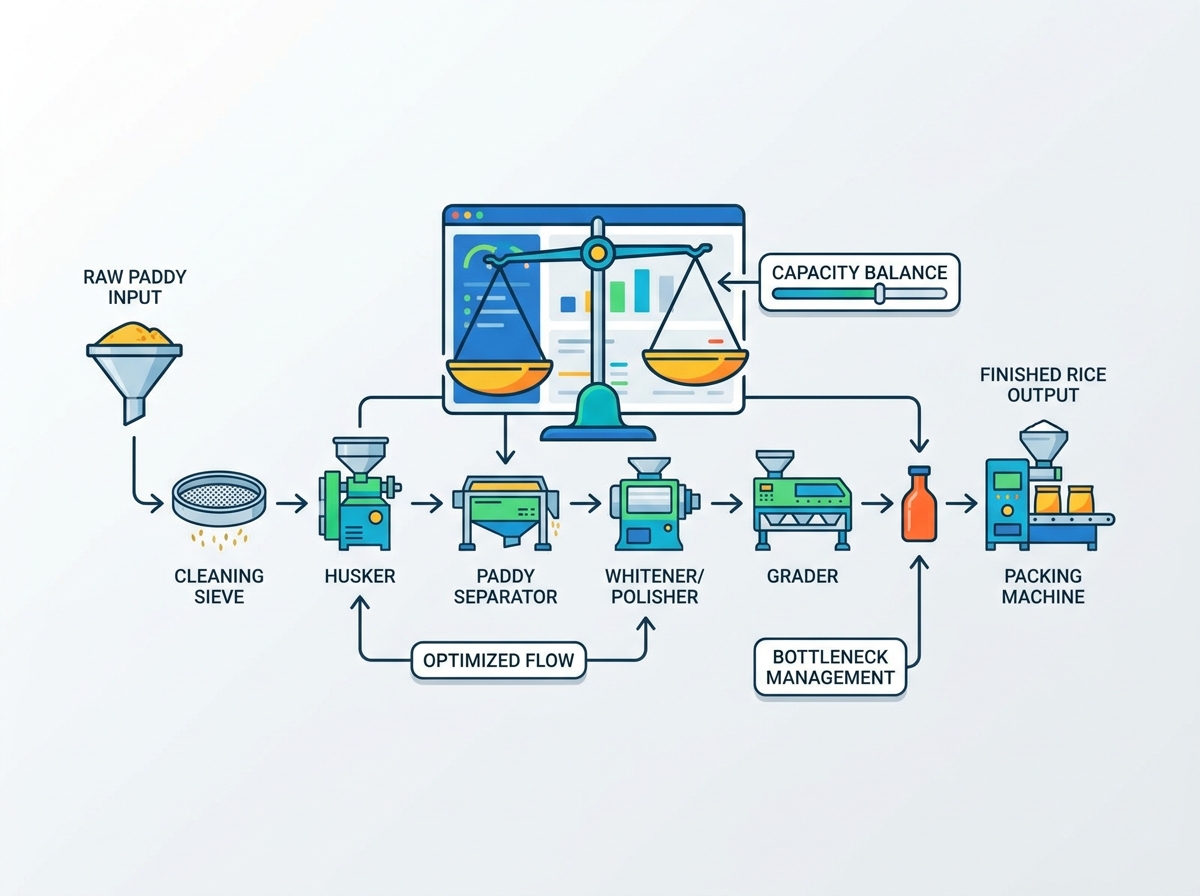
Engineering a balanced facility requires abandoning the assumption of uniform machinery sizing. Because the physical mass of the product decreases as impurities, husks, and bran are stripped away, downstream equipment must be sized according to a strict mass balance model. An automatic rice milling plant relies on these tapering throughput ratios to maintain steady material flow without overloading sensitive finishing equipment.
A standard mass balance calculation assumes that 100% rough paddy yields approximately 80% brown rice after hulling. Following the whitening and polishing stages, the final output of milled white rice typically sits between 68% and 72%, depending on the genetic variety of the crop and the desired degree of milling. Sizing a color sorter or a packaging scale for the initial 10-ton-per-hour intake capacity wastes capital and floor space. These downstream units must be specified based on the actual milled output.
Processing Stage | Input Material | Byproduct Removed | Estimated Mass Retention | Required Capacity (Based on 10 TPH Intake) |
|---|---|---|---|---|
Intake & Pre-cleaning | Rough Paddy (Field Grade) | Straw, Stones, Dust | 100% | 10.0 TPH |
Hulling & Separation | Cleaned Paddy | Husks (approx. 20%) | ~97% (Post-cleaning) | 9.7 TPH |
Whitening & Milling | Brown Rice | Bran (approx. 8-10%) | ~80% (Husks removed) | 8.0 TPH |
Polishing & Grading | Milled White Rice | Fine Bran, Water Mist | ~70% (Bran removed) | 7.0 TPH |
Color Sorting & Packaging | Finished White Rice | Discolored/Broken Kernels | ~68% (Brokens removed) | 6.8 TPH |
Continuous-flow manufacturing relies on decoupling interdependent stages. Buffer storage serves as the critical shock absorber in this system, managing stochastic flow fluctuations and preventing cascading shutdowns. If a downstream polisher needs a five-minute pause for a screen change, an upstream huller should not have to shut down immediately. Surge bins provide this necessary operational elasticity. Without them, a single tripped motor halts the entire production line instantly.
Strategic placement of these bins dictates plant efficiency. Engineers typically install surge bins immediately before the huller, ensuring a constant, gravity-fed supply of clean paddy. A starved huller operates inefficiently and wears out rubber rollers unevenly. Another critical buffer zone belongs before the whitening section, allowing brown rice to cool slightly and stabilize before undergoing high-friction milling. Placing a large buffer silo before the packaging line ensures that bagging scales can operate continuously, even if the main milling line temporarily drops its output rate. You must equip all surge bins with high and low-level rotary paddle switches or capacitive sensors to communicate with the central control system.
Plant managers must balance competing physical variables: maximum throughput, minimum grain breakage, and total energy consumption. Pushing machines to their absolute capacity limits usually degrades the head rice yield, turning valuable whole kernels into lower-value broken rice. Multi-objective optimization requires finding the precise feed rate where throughput is maximized without crossing the threshold of kernel degradation. Operators adjust counterweights on whitener discharge gates to control internal chamber pressure, finding the sweet spot between milling degree and breakage.
Integrating Resource Efficient and Cleaner Production (RECP) principles further optimizes the facility. This involves turning waste streams into utility assets. Routing husks directly from the huller to a biomass boiler provides thermal energy for the drying stage. This closed-loop system reduces reliance on external grid power, lowers operational overhead, and eliminates the logistical burden of hauling away massive volumes of loose husks. Ash from the biomass boiler can then be sold as a soil amendment or used in industrial applications, creating an additional revenue stream from a former waste product.
The front end of a commercial rice mill line dictates the rhythm for the entire facility. Intake elevator speeds must perfectly match pre-cleaner screen capacities. If the bucket elevators lift wet paddy faster than the vibratory screens can remove straw and stones, the intake pit will back up, delaying truck unloads. Pre-cleaners must be oversized relative to the main milling line to handle the heavy impurity loads typical of rapid mechanical harvesting. You need scalperators with large mesh screens to remove large foreign objects before they damage downstream elevators.
Drying system selection depends heavily on daily processing volumes and space constraints. Continuous flow dryers suit massive, steady-state operations where paddy moisture is relatively uniform. Recirculating batch dryers offer superior control for preserving grain integrity, particularly when dealing with highly variable moisture levels from different farm sources. Proper drying prevents fissuring inside the kernel, which is the primary defense against breakage during the subsequent whitening stage. Operators must monitor the drying air temperature closely; exceeding safe limits causes the starch inside the kernel to stress and crack.
Hulling requires precision equipment to strip the abrasive silica husk without crushing the fragile brown rice inside. Pneumatic rubber roller hullers achieve this through differential roller speeds, typically operating with a speed difference of 2.5 to 3 meters per second. Assessing their capacity requires looking at their cooling requirements. Hot rubber degrades rapidly, reducing hulling efficiency and increasing downtime. Dedicated aspiration systems must pull ambient air across the rollers to maintain optimal operating temperatures. Operators must select the correct rubber shore hardness based on the specific paddy variety being processed.
Whitening equipment selection dictates the final quality of the grain. Vertical whiteners utilize gravity and internal pressure to strip bran, offering a smaller footprint and aggressive milling action suitable for hard, high-yield long-grain varieties. Horizontal whiteners apply gentler friction over a longer physical path, making them ideal for fragile short-grain varieties prone to snapping. Plant designers must match the whitener type and its motor capacity to the specific genetic profile of the locally harvested crop. Emery roll grit size must be selected carefully; coarser grits remove bran faster but increase the risk of scratching the endosperm.
End-of-line equipment finalizes the product value. Sizing optical color sorters requires a different metric than upstream machinery. Sorters must be specified based on the expected percentage of defective grains (chalky, discolored, or peck-damaged kernels) rather than just total volumetric flow. A high defect rate requires slower feed speeds to allow the pneumatic ejectors time to fire accurately. If local crops historically suffer from high defect rates, the color sorting capacity must be over-engineered. Modern sorters use full-color RGB cameras and InGaAs sensors to detect subtle color variations and foreign materials like glass or light stones.
Automated bagging lines must synchronize with the continuous output of the grading section. If the packaging scale operates slower than the color sorter, finished rice will pile up in the final surge bin, eventually triggering a high-level sensor that shuts down the entire milling line. Dual-scale bagging machines provide redundancy, ensuring that packaging keeps pace with production even during roll changes for bagging film or thread. Load cells on the bagging scales require regular calibration to prevent product giveaway or underweight bags.
Modern milling relies heavily on digital oversight. PLC control systems act as the central nervous system of the plant, coordinating hundreds of moving parts simultaneously. Automated flow gates equipped with variable frequency drives (VFDs) dynamically adjust feed rates into individual machines. If a whitener's motor begins drawing excessive amperage—indicating a potential choke—the PLC instantly signals the upstream VFD to reduce the feed rate, preventing a physical blockage. This closed-loop control prevents catastrophic equipment failure and reduces operator fatigue.
Sensor data bridges the technology gap efficiency between legacy operations and modern facilities. Moisture sensors, temperature probes, and motor load monitors feed continuous data back to the control room via SCADA systems. This allows the system to adapt to different rice varieties on the fly. If a batch of particularly dry brown rice enters the system, the automation logic can reduce the pressure in the polishing chamber to prevent shattering, maintaining steady-state operations without human intervention. Operators monitor the entire plant from a central HMI (Human Machine Interface), tracking yield metrics and energy consumption in real time.
Capital constraints often dictate building a facility in phases, making modular expansion a critical design parameter. Layout planning must accommodate future capacity doubling from day one. This means leaving physical floor space adjacent to current machinery for parallel whiteners, secondary color sorters, or additional packaging lines. Attempting to cram new equipment into a tight layout later disrupts workflow and creates dangerous maintenance environments. Walkways must remain clear, and forklift access to packaging areas must be preserved.
Foundational infrastructure must be oversized during initial construction. Upgrading a main electrical panel or expanding a compressed air network later is highly disruptive and expensive. Engineers should install oversized dust collection ductwork with blind flanges for future connections. High-capacity air compressors and heavy-duty electrical conduits should be installed during the primary build. When it is time to add a second milling line, operators simply bolt the new machines to the floor and connect them to the existing, pre-sized utility backbone.
Risk: Over-specifying vs. Under-specifying Machinery
Impact: Purchasing oversized downstream equipment traps capital in unused capacity. Undersized primary cleaners cause chronic choking, limiting the entire plant's output to the speed of its weakest link. A 15 TPH cleaner feeding a 10 TPH dryer creates an immediate bottleneck.
Mitigation: Demand a verified, mathematically sound mass balance flow diagram from the equipment manufacturer before procurement. Ensure every machine's rated capacity aligns with the tapered throughput model.
Risk: Byproduct and Non-Product Output Bottlenecks
Impact: Undersized bran conveyors or inadequate dust cyclones will rapidly back up into the main milling line. When bran cannot escape the whitening chamber, friction spikes, grain burns, and the system forces an emergency shutdown.
Mitigation: Apply rigorous RECP audits during the design phase. Ensure that byproduct handling capacities exceed the maximum theoretical waste generation rates by at least 20% to handle sudden surges. Size rotary airlocks for maximum volumetric displacement.
Risk: Utility and Power Constraints
Impact: Voltage drops cause high-draw motors to stall under load. Insufficient compressed air volume causes automated pneumatic gates and color sorter ejectors to fail, leading to massive material blockages and degraded sorting accuracy.
Mitigation: Conduct a comprehensive utility audit prior to installation. Specify dedicated, isolated compressors solely for color sorters to guarantee consistent air pressure. Install separate electrical circuits for high-draw motors like whiteners and hammer mills. Size air receivers appropriately to handle peak pneumatic demand.
Risk: Maintenance Downtime and Spare Parts
Impact: In a tightly coupled continuous line, a single broken elevator belt or a shattered bearing halts the entire operation, costing thousands in lost production hours. Waiting weeks for a proprietary replacement part destroys profitability.
Mitigation: Standardize motor frames, belt sizes, and bearing types across the entire plant to reduce inventory complexity. Maintain a strict on-site inventory of high-wear items, including rubber rollers, milling screens, emery rolls, and elevator buckets.
Commission a site-specific engineering audit to evaluate your current intake, drying, and milling capacities against your actual seasonal harvest volumes.
Request a detailed 3D plant layout from your equipment vendor to verify that adequate floor space exists for buffer silos, byproduct conveyors, and future modular expansion.
Calculate your exact throughput tapering ratios based on the specific genetic rice varieties you process, ensuring downstream equipment is sized for final milled output, not initial paddy intake.
Upgrade your utility infrastructure immediately, focusing on dedicated compressed air lines for optical sorters and oversized dust collection systems to prevent secondary bottlenecks.
A: A highly optimized facility typically achieves a 68% to 72% head rice yield from rough paddy. The remaining mass is lost through the removal of impurities, husks (roughly 20%), and bran layers (roughly 8-10%). Yield fluctuates based on raw paddy moisture, genetic variety, and the precision of the milling equipment.
A: Plants must decouple the stochastic arrival of grain from steady-state milling. This requires high-capacity intake pits, robust pre-cleaning systems, and adequately sized wet-paddy buffer silos. These buffers absorb the massive influx of trucks, allowing the drying and milling stages to operate continuously at their designed optimal speeds.
A: Whitening generates intense friction and heat, requiring precise feed rates. Bottlenecks occur if upstream hullers push brown rice faster than the whiteners can process it. If fed too quickly, the aspiration system fails to cool the grain, causing massive kernel breakage and forcing the operator to halt production.
A: Buffer silos act as operational shock absorbers. By placing surge bins between critical stages, upstream machines can continue running temporarily even if a downstream machine pauses for minor adjustments, screen changes, or roll replacements. This decoupling prevents minor maintenance tasks from halting the entire facility.
A: Yes. Undersized byproduct handling lines are a primary cause of plant failure. If bran conveyors or dust collection cyclones lack capacity, waste material backs up into the primary milling chambers. This chokes the machinery, spikes motor temperatures, and forces an immediate, messy system shutdown.
A: Color sorters and packaging equipment must always be sized for the final milled volume. Because husks, bran, and impurities are removed upstream, the final output is typically 30% less than the initial paddy intake. Sizing downstream equipment based on intake tonnage wastes significant capital.
A: Yes, through modular expansion strategies. However, this requires oversizing foundational infrastructure during the initial build. Operators must install oversized dust collection ductwork, high-capacity compressed air systems, and heavy-duty electrical panels on day one to avoid costly, disruptive retrofits when adding new machinery later.